

Industrial software developer · Basel, Switzerland

From sensor to control room, a single software partner

EXETOPIA designs and builds the HMI, desktop applications, mobile applications and embedded firmware that drive your sensors, devices and production lines. One single contact, from prototype to commissioning.
  • Reply within 24 working hours
  • Scoping and detailed quote at no cost
  • Source code delivered, no lock-in
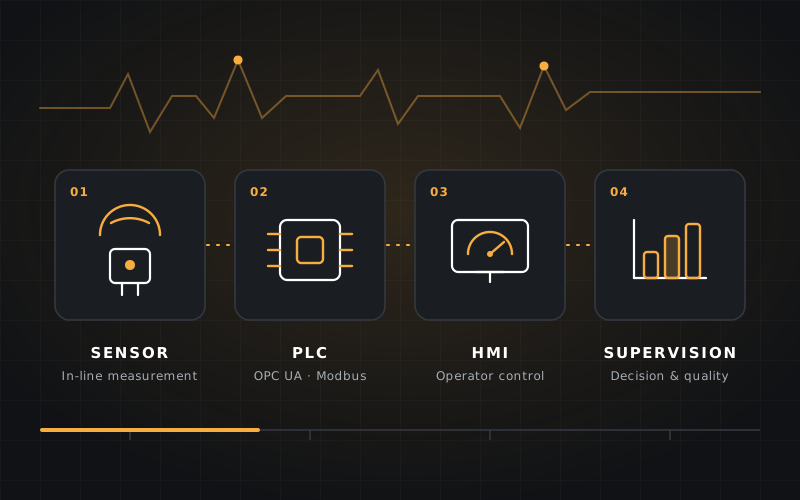
Industrial chain diagram: sensor, PLC, HMI and supervision linked by a data flow
  • 35 years

    of combined industrial experience in the team

  • 40+

    software projects delivered since 2022

  • 6

    sectors served, from automotive to energy

  • 24 h

    to get a first technical response

The starting point

Your machine runs fine. Your software is what slows you down.

Three situations come up on almost every shop floor we work with. If one of them sounds familiar, we know what to do.

Off-the-shelf software that falls short

The manufacturer's solution covers 70 % of your process. The remaining 30 % lives in a spreadsheet, a notebook and the memory of an operator about to retire.

An HMI that causes mistakes

Cluttered screens, unreadable alarms, actions buried three menu levels deep. Every moment an operator hesitates costs cycle seconds and scrap.

Data nobody uses

Your PLCs generate thousands of data points every hour. Without the right visualisation, they serve neither diagnostics nor quality.
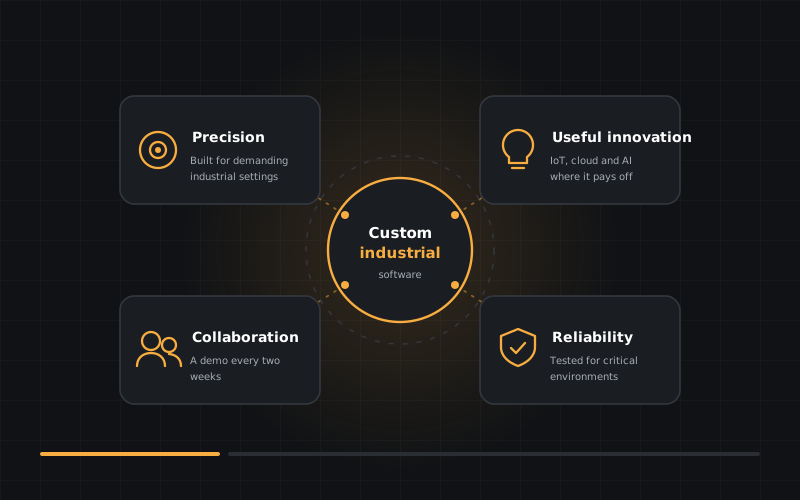
The four EXETOPIA values around its core expertise: precision, useful innovation, collaboration and reliability

Who we are

Engineers used to working on the shop floor and in the field

Since 2022, EXETOPIA has supported manufacturers who want to digitise their tools and modernise their human-machine interfaces. Our team combines technical software expertise with a concrete understanding of production constraints: cycle time, safety, dust, gloves, line stoppage.

  • Precision — software built for demanding industrial environments, not for a demo.
  • Useful innovation — IoT, cloud and AI built in where they solve a real problem.
  • Collaboration — agile approach, regular demos with your production teams.
  • Reliability — solutions tested and validated for critical environments.

Our services

Four areas of expertise, one continuous software chain

Every layer of your installation has its own constraints. Pick the one that concerns you: the page details the features, technologies and use cases.
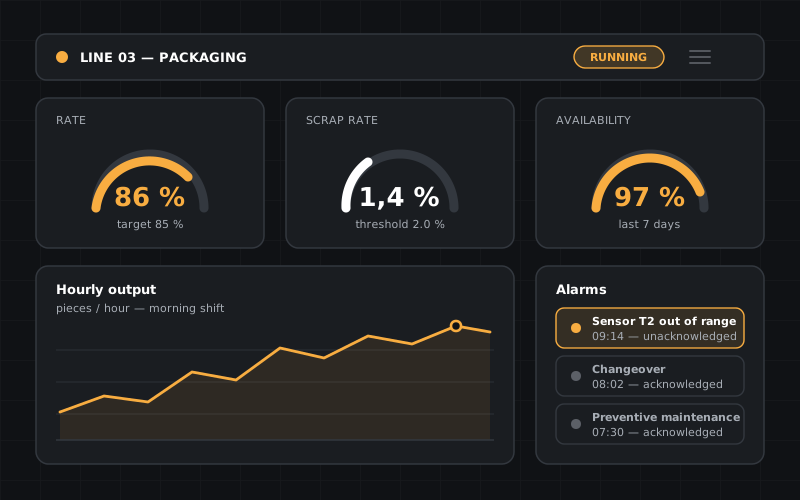
01 Industrial supervision screen with cycle rate gauges, production curve and alarm log

HMI & supervision

Readable, ergonomic and robust operator interfaces to control your machines: real-time supervision, alarm management, touch panels.
  • SCADA
  • OPC UA
  • Qt/QML
  • .NET WPF
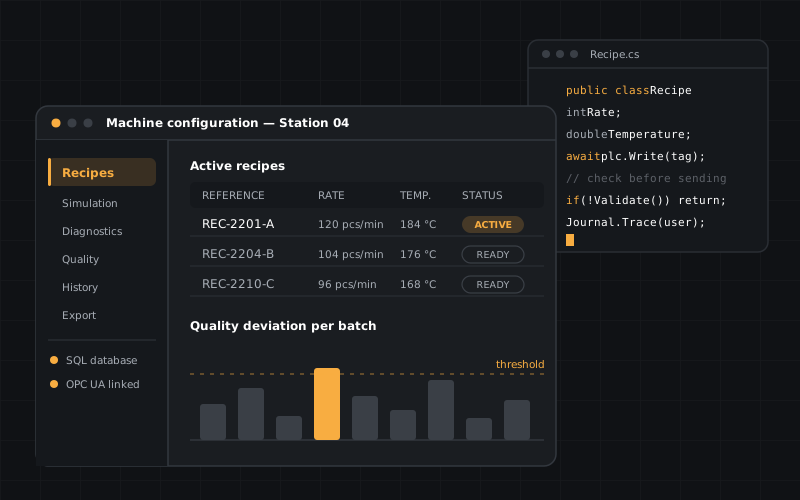
02 Industrial desktop application window: machine recipe table, quality histogram and code panel

Desktop applications

Stable, fast business software for your workstations: machine configuration, simulation, diagnostics, quality analysis and reporting.
  • C++ / Qt
  • C# .NET
  • SQL
  • 3D / OpenGL
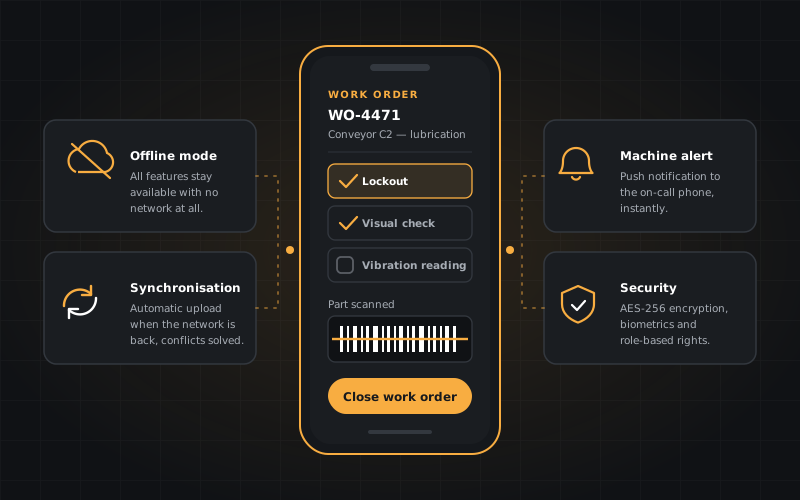
03 Mobile maintenance application: work order on a smartphone, barcode scan and offline synchronisation

Mobile applications

Mobility for your technicians: work orders, readings, code scanning, machine alerts and offline operation in areas without coverage.
  • Android
  • iOS
  • Flutter
  • Offline
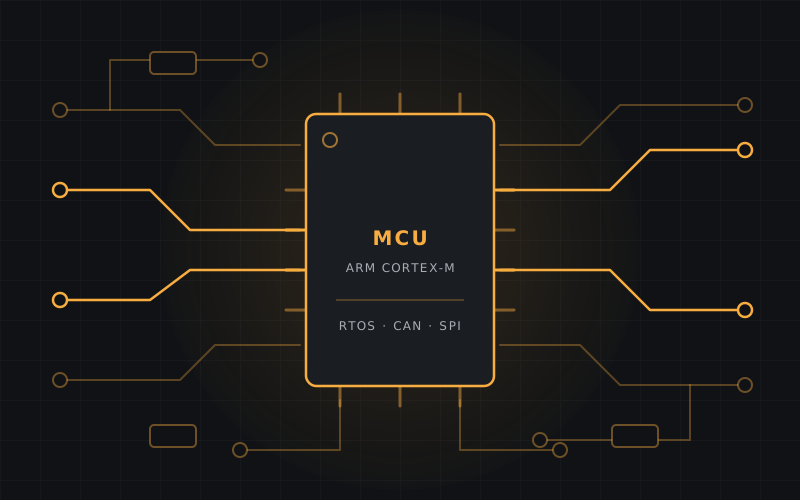
04 Embedded circuit board with ARM Cortex-M microcontroller and printed circuit traces

Embedded systems

Real-time firmware optimised for your boards and microcontrollers: controlled latency, small memory footprint, secure remote updates.

  • C / C++
  • FreeRTOS
  • STM32
  • Yocto

Our method

Four stages, no surprises at the end of the project

You approve a scope, a budget and a schedule before the first line of code. After that, a demo every two weeks.

  1. On-site scoping

    We come and see the machine, the shop floor and the operators. We leave with the real constraints, not a theoretical specification.

  2. Mockup and architecture

    Clickable screens, technology choices, integration plan for the existing system. You approve before any development commitment.

  3. Iterative development

    Two-week sprints, a demo at the end of each sprint, automated tests and sign-off by your production teams.

  4. Commissioning and support

    Rollout, operator training, documentation delivered with the source code, then maintenance and enhancements on request.
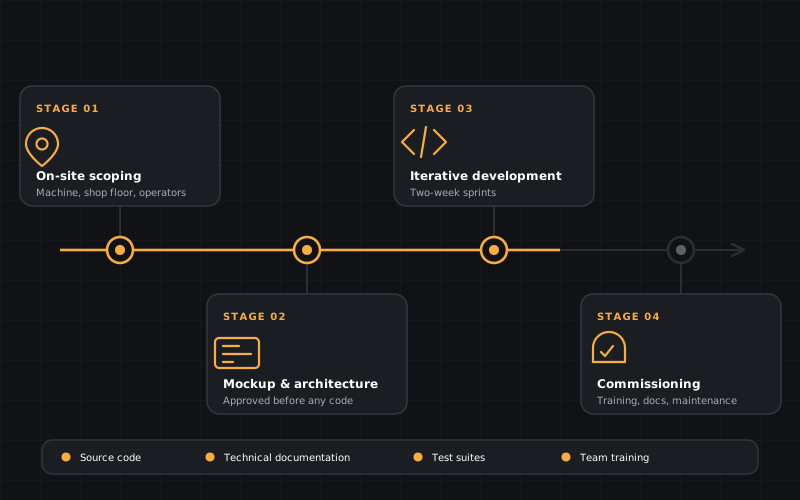
Timeline of the four project stages: on-site scoping, mockup and architecture, iterative development, commissioning

What you get on delivery

  • The complete source code, with its build environment and deployment scripts.
  • The technical documentation and the operator manual, in English, German or French.
  • The test suites automated, plus the validation report on your own hardware.
  • Training for your production and maintenance teams, on site or remotely.

Sectors served

We already speak the language of your industry

Automotive, aerospace, energy, food and beverage, robotics, special machinery: every sector has its own standards, validation cycles and shop-floor habits. We factor them in at the scoping stage rather than at acceptance.
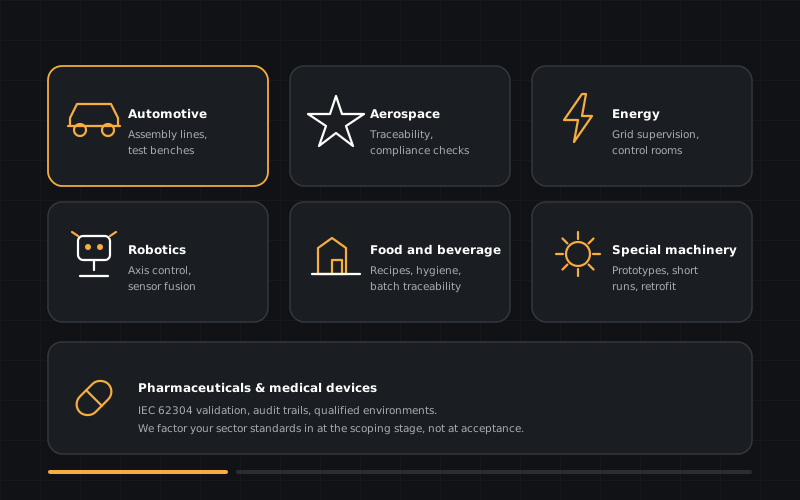
  • Automotive
  • Aerospace
  • Energy
  • Food and beverage
  • Robotics
  • Special machinery
  • Pharmaceuticals
Sectors served by EXETOPIA: automotive, aerospace, energy, robotics, food and beverage, special machinery and pharmaceuticals

Frequently asked questions

What manufacturers ask us before getting started

An HMI prototype or a focused business application is ready in 4 to 8 weeks. A complete project including PLC integration, on-line testing and commissioning typically runs 3 to 9 months, depending on scope and your validation requirements.

Yes. We integrate Beckhoff, Siemens, Schneider Electric and Allen-Bradley PLCs, along with the OPC UA, OPC DA, Modbus RTU/TCP, CAN, Profibus, Profinet, EtherCAT, EtherNet/IP, MQTT and AMQP protocols. No equipment replacement is needed to get started.

You do. The code is delivered with its technical documentation, build scripts and build environment. You remain free to maintain it in-house or to hand its development to another supplier.

Yes. An optional support contract covers bug fixes, functional enhancements, compatibility with new operating system versions and an on-call service for critical applications, with contractual response times.

Yes. We start with an audit of the code and its architecture, then propose either a maintenance handover, a gradual modernisation, or a targeted rewrite of the blocking modules only.

Let's talk about your industrial project

Describe your need in a few lines: an engineer gets back to you within 24 working hours with a first technical opinion, with no obligation.